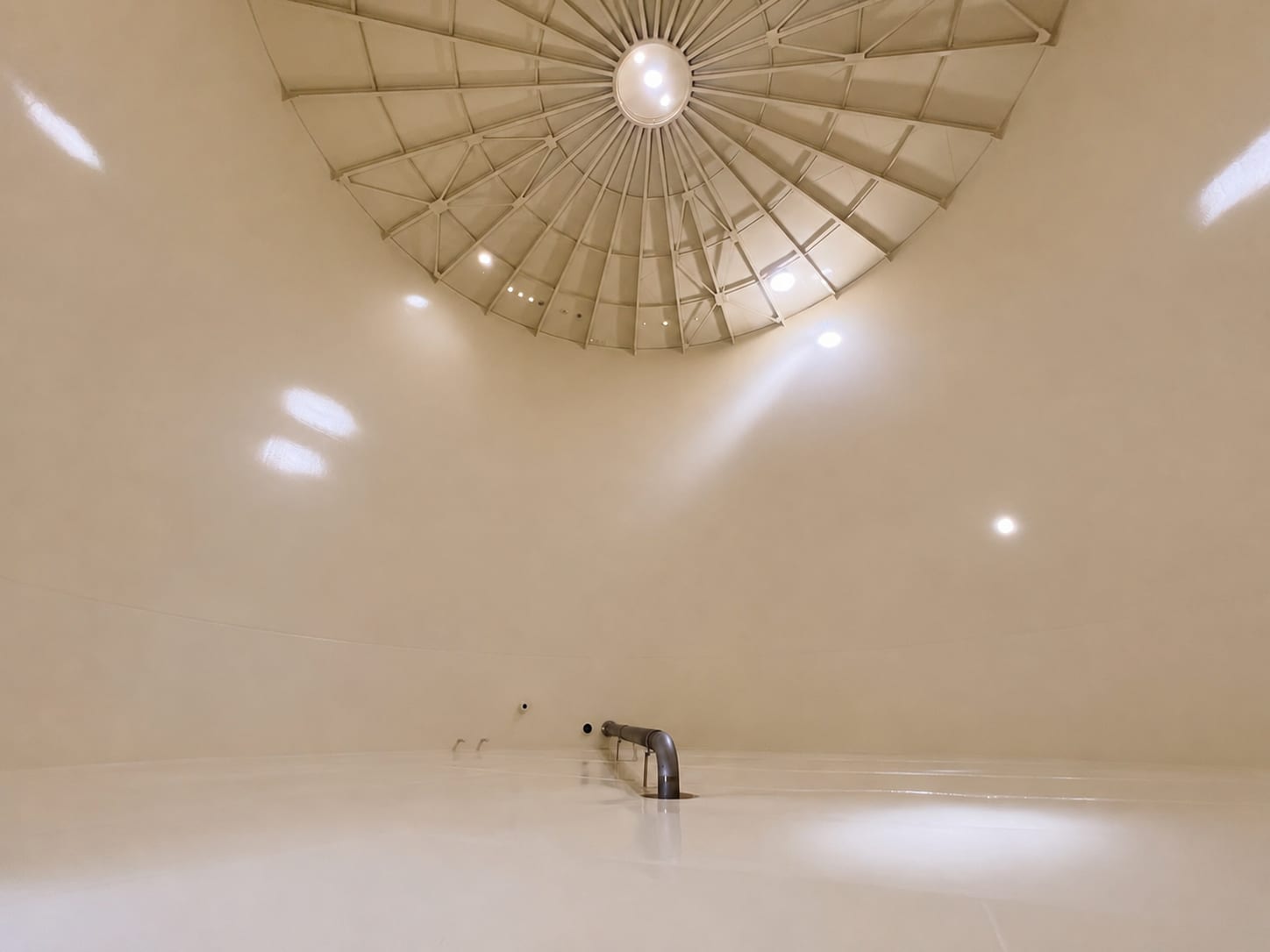
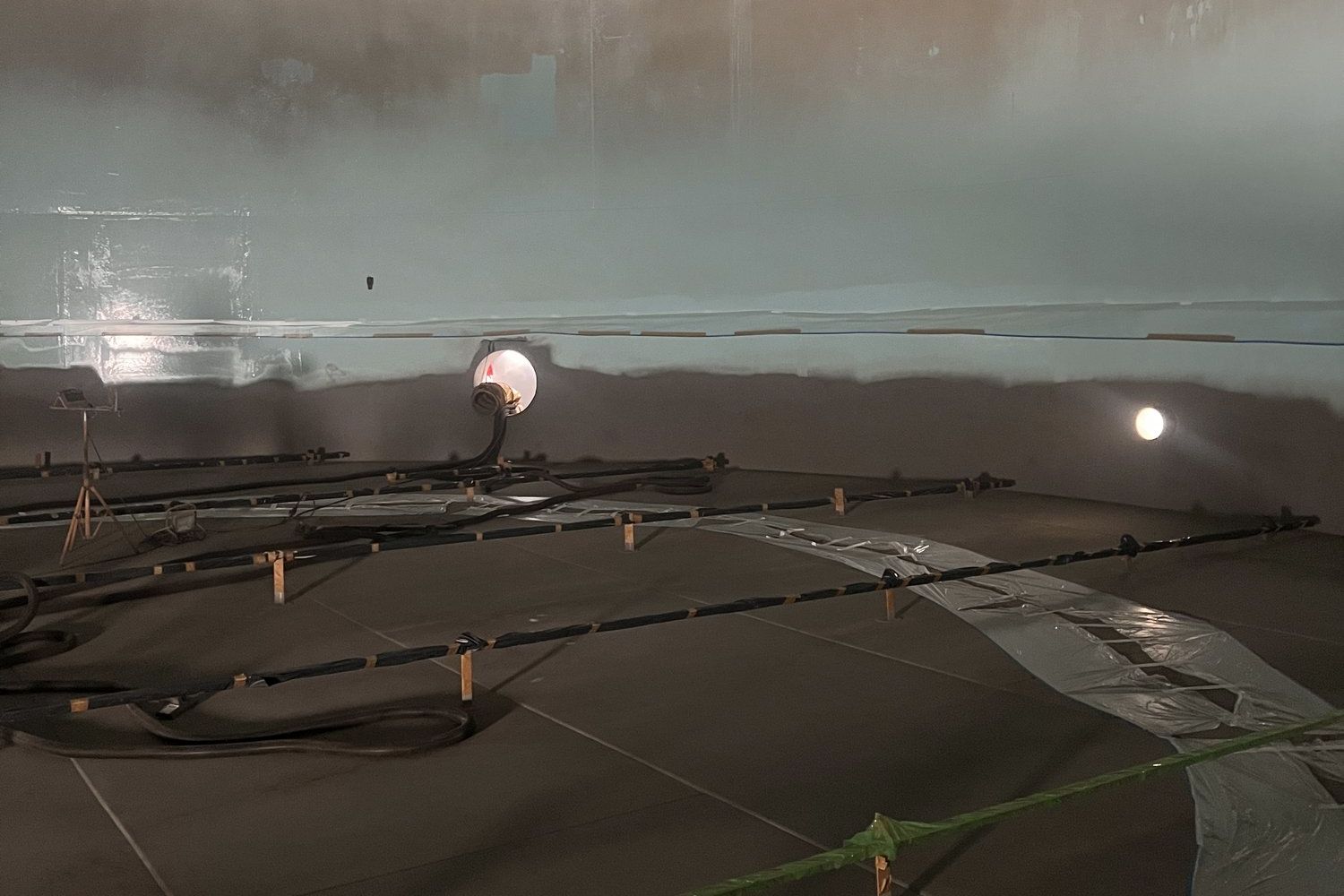
A tank lining works under the harshest conditions imaginable: permanently immersed in the stored product. This is how a professional tank lining is built, from preparation to spark testing, following the standards we apply every day.
No coating works harder than a tank lining. Where a facade coating sees the occasional rain shower, a tank lining is in direct contact with fuel, chemicals or process water day and night. One weak spot is enough for corrosion, product contamination or a failed inspection. That is why industrial painting on tanks is held to the most demanding standards in the trade, and why everything starts with preparation.
What is the difference between tank coating and tank lining?
Tank coating is the broad term for any protective layer on a storage tank, inside and out. Tank lining is more specific: the internal, immersion-grade system in direct contact with the stored product. In practice the terms are used interchangeably; this article covers both, with the emphasis on the lining, because that is where the requirements are highest.
Why a tank is the harshest environment for any coating
In immersion service the coating never gets a break. Osmosis drives moisture and dissolved substances through microscopic weak spots, temperature swings work the steel shell, and aggressive products test the chemical resistance of every square centimetre. Defects that would stay invisible for years on an ordinary exterior coating lead to blistering or under-rusting inside a tank within months. The bar for execution and inspection is therefore set a level higher: cleanliness grade Sa 2½ to Sa 3, controlled film thicknesses and a conclusive pinhole test before the tank returns to service.
Interior and exterior: two different challenges
The interior (the lining) must chemically withstand the stored product. The exterior fights on another front: weather, UV, sea air and corrosion under insulation. Each demands its own system choice:
- Interior: chemically resistant systems, typically epoxy phenolic or epoxy novolac. Total dry film thickness varies by product and service conditions from roughly 300 µm to more than 1,000 µm; the data sheet and project specification always govern.
- Exterior: a classic multi-coat system with zinc-rich primer, epoxy intermediate and polyurethane topcoat for colour and UV stability.
- Tank roofs and walkways: additional anti-slip and roof coating work, often combined with fall-protection zones.
Choosing the right lining system
The stored product dictates the system. The coating manufacturer publishes a resistance list per product; you never deviate from it. As a guideline:
| Stored product | Typical lining system | Key consideration |
|---|---|---|
| Diesel, gas oil, fuel oil | Epoxy (standard or phenolic) | Conductivity and static charge |
| Chemicals and solvents | Epoxy novolac or phenolic | Manufacturer resistance list is binding |
| Process water, firefighting water | Solvent-free epoxy | Osmosis resistance |
| Drinking water | Certified epoxy | Approval per country (Belgaqua, KTW, WRAS) |
| Food products and edible oils | Epoxy with food-contact approval | Approval per product and application |
| High temperature or changing cargo | Epoxy novolac, glass flake reinforced | Thermal cycling and impact |
Typical lining systems per stored product
The execution, step by step
1. Gas-freeing, cleaning and inspection
A tank is a confined space: atmospheric testing to confirm gas-free conditions, ventilation and permits come before anything else. Product residue is then removed and the condition of floor, shell and weld seams is assessed. Pitting corrosion or floor deformation must surface now, not after blasting.
2. Blasting to Sa 2½ or Sa 3
For immersion service, manufacturers specify cleanliness grade Sa 2½ to Sa 3, with an angular blast profile matched to the film thickness. How that blasting works in detail, from cleanliness grades to surface profile, is covered in our guide on preparing steel for coating. Inside a tank one extra factor applies: every gram of blast dust has to come back out as well, verified with the dust test to ISO 8502-3.
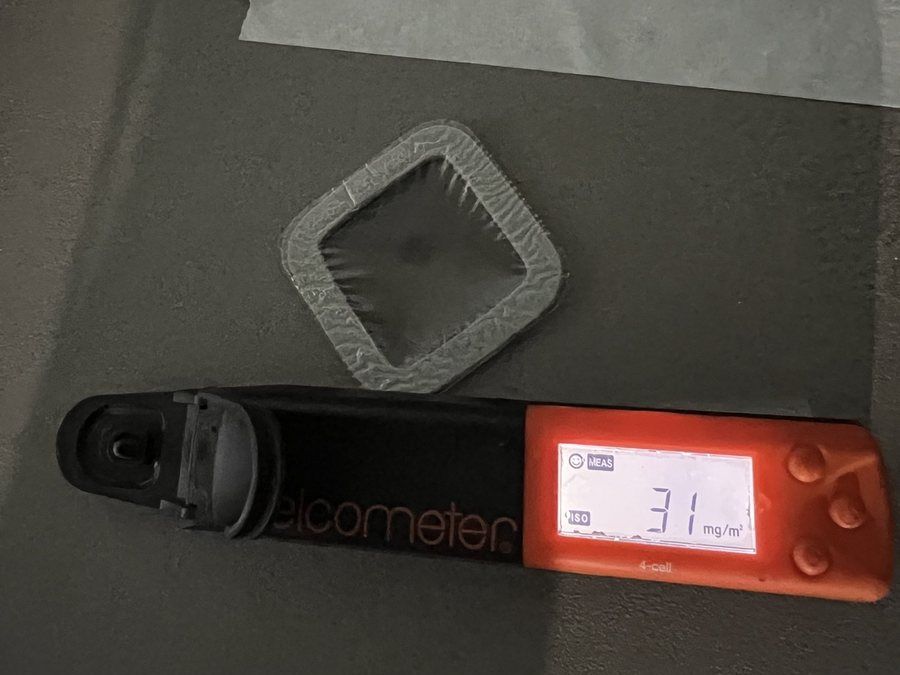
3. Measuring soluble salts
Chlorides and sulphates on the steel later draw moisture through the coating (osmosis) and are the hidden failure factor in immersion service. We measure them with the Bresle method to ISO 8502-6 (or via conductivity to ISO 8502-9), then clean and re-measure until the value sits below the manufacturer limit, typically 20 to 50 mg/m² depending on the product.
4. Climate control
Inside a closed tank you set the climate yourself. With dehumidification and ventilation we keep relative humidity low and the steel above the dew point, so no flash rust forms between blasting and coating. Climate data is logged continuously, from the first blast to the final coat.
5. Stripe coats and application
Weld seams, corners and bolts first receive a manual stripe coat: exactly where a sprayed film pulls thin. The system is then airless-sprayed in controlled passes to the specified thickness, with wet film measurements during the work and dry film thickness (DFT) checks after each coat has cured.
Quality control before the tank returns to service
- Dry film thickness (DFT): measured on a fixed grid across floor and shell (ISO 19840); both the average and the minima must be within the project specification.
- Holiday detection: low-voltage or high-voltage detection, depending on the coating system and film thickness, traces pores and pinholes in the lining. In immersion service a single missed pore is enough for through-rusting, so this test is non-negotiable.
- Adhesion and cure: cure verification and, where specified, adhesion testing before the tank is returned to service.
- Reporting: all measurements (climate, salts, profile, DFT, spark test) in one inspection dossier for owner and inspector.
Repair locally or fully reline?
Not every tank needs a full reline straight away. With local damage, spot repair can be a fully sound solution: the zones are blasted locally (for example vacuum blasting, without spreading grit), the edges are feathered and the system is rebuilt coat by coat to the original thickness. If the lining is aged, widely disbonded or chemically attacked, a full reline is the only durable choice. Have a look at our completed tank projects to see what both approaches look like in practice.
Common mistakes
- Coating over an insufficient cleanliness grade because "it looks clean".
- Skipping salt measurements; salts are invisible but fatal in immersion.
- Leaving out stripe coats on weld seams, corners and bolted connections.
- Skipping the spark test, or running it before the coating has fully cured.
- Choosing a system on price instead of the manufacturer resistance list.
- Filling the tank too early, before the coating has chemically cured.
Frequently asked questions
How long does a tank coating last?
As a rule of thumb, a professionally applied tank lining lasts 10 to 20 years, but there is no universal service life: the stored product, temperature, cleaning regime and number of cargo changes make the difference. Periodic inspection (visual plus film thickness measurements) extends that life, because local damage gets repaired before under-rusting can develop.
What is holiday detection or spark testing?
A holiday test finds invisible pores and pinholes in a coating using a low-voltage or high-voltage detector, depending on the coating system and film thickness; the method and test voltage follow the data sheet and project specification. In immersion service this test is essential: one missed pore is enough for local through-rusting of the tank shell.
Which coating suits chemical storage?
For chemicals and solvents, epoxy novolac or epoxy phenolic systems are typically used, offering higher chemical and temperature resistance than standard epoxy. The coating manufacturer’s resistance list determines suitability per product; it is never deviated from.
How long is a tank out of service for a new lining?
Allow several weeks for a full reline: gas-freeing, cleaning, blasting, coating in multiple coats and chemical curing. The cure time before the tank may be refilled is product-specific and stated in the datasheet; cutting it short is the fastest route to premature failure.
Can a damaged tank lining be repaired locally?
Yes. With local damage the zones are blasted locally, the edges of the existing coating are feathered and the original system is rebuilt coat by coat to the specified thickness, followed by a new holiday test on the repaired zones, provided the surrounding lining still adheres well.
Curious how we handle this as a contractor, from blasting to holiday testing? Have a look at our tank coating and tank lining service page.
Need help with your tank project?
Tank protection to the standard
Russo NV delivers tank coating and tank lining from blasting to holiday testing, performed under VCA-certified safety procedures and the applicable ISO and AMPP inspection standards, with a complete measurement dossier at handover. Request a no-obligation quote or advice.
Request a quote